Tuesday, July 1, 2008

Pissing Away Our Future

How much longer are we going to have to listen to the pundits tell us that the globalized economy is the key to our economic well-being. We no longer produce anything here in America, without production, the only thing that we have to trade are our assets. And that is what we are doing. Foreign investors are buying up our companies piecemeal or entirely. Our own companies have relocated offshore.

Our entire country has become the third generation rich kids, inheritors of a great fortune, who don’t work, but just want to lay on the beaches of Florida and sort cocaine at Hollywood parties until they realize that they aren’t rich anymore.


The Stock Market Reflects The Selling Of America


The reason that our economy has not completely tanked is that our assets are becoming cheaper and cheaper to the foreign investor. That is all that has kept the stock market from taking a dive into oblivion, like in 1929. Please click on the graph to see how cheap our assets have become for the foreign investor. Look at the value of the Dow as measured in Euros. If it weren’t for foreign investment we would be deep in depression. The size of the foreign investment means that we are rapidly selling off all of our assets to maintain a standard of living that is not sustainable without actual production here in the United States.

If we want to save our country we must stop the Fed from further devaluation of the currency. The Fed needs to raise interest rates to 10% until we can get off the addictive fiat money and back our currency with something real. We must balance the Federal budget and immediately end our costly adventures overseas. And we must impose tariffs on ALL imports into the United States of 12%, equally, across the board. Otherwise we are going to be the servants of the rest of the world.

Friday, June 27, 2008

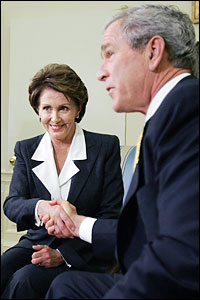
Letter to Nancy Pelosi before Bush-War Part III

The news sources from left and right and from east and west all agree that Israel or the United States is almost certain to attack Iran soon, and definitely to do so before Bush leaves office if Obama is elected.

I couldn't help but remember the machinations of the Speaker of the House, when she took the War Funding Bill of 2006 into committee and struck the language that required Bush to receive Congressional authorization before initiating any attack on Iran. See here She was elected to stop the war, and she has the nerve to say that she has worked to stop the war. She quietly enabled Bush to broaden the war!

So I decided to send the lady a letter. If you would like to send her a letter as well, you can copy mine and paste it into the link to her email below, or write your own letter. Let's tell her that we know what she did. Let's let her know that we will hold her responsible for all the deaths that result from this mindless act.


Mrs. Pelosi,

It appears that the President is preparing to attack Iran or to support an Israeli attack on Iran. The country is decidedly against that course of action, but our hands are tied. Apparently there is nothing that we can do to stop the lame duck President from bombing Iran on his way out of Washington.

There is one person responsible for our impotence to stop this insane and illegal act, and that person is you.


You cut the language that would have required Congressional approval for any attack on Iran from the war-funding bill two years ago. There was no justification for what you did. Your mandate was to get us out of war in the Mid East, and instead you empowered the President to open a new front. You did it behind closed doors and never even explained why you did so.

Well, I imagine that you have invented some powerful spin to justify an act that will result in thousands of deaths and a further decay in America's reputation. Polish up the spin, because after the bombs fall, people will start to ask a lot of questions, and they will all end up knocking on your door.

I hope that you can live with your conscience. May God forgive you,


Chris Ferrell

To send this letter to Mrs. Pelosi, just copy and paste it into her Speaker of the House email here. If you would rather express your sentiments more personally, then write your own letter and paste it into the link.

An American Hero

Ron Paul Speech on the Floor of the House - June 27 2008


Please listen to this man. The foreign policy and the fiscal policy of our once great Republic have been turned on their heads. We must stop this careen towards the precipice.

Thursday, June 26, 2008

Democracy and Freedom

A speech given by Congressman Ron Paul

“…man is not free unless government is limited. There’s a clear cause and effect here that is as neat and predictable as a law of physics: As government expands, liberty contracts.” -President Ronald Reagan

We’ve all heard the words democracy and freedom used countless times, especially in the context of our invasion of Iraq. They are used interchangeably in modern political discourse, yet their true meanings are very different.


George Orwell wrote about “meaningless words” that are endlessly repeated in the political arena. Words like “freedom,” “democracy,” and “justice,” Orwell explained, have been abused so long that their original meanings have been eviscerated. In Orwell’s view, political words were “Often used in a consciously dishonest way.” Without precise meanings behind words, politicians and elites can obscure reality and condition people to reflexively associate certain words with positive or negative perceptions. In other words, unpleasant facts can be hidden behind purposely meaningless language. As a result, Americans have been conditioned to accept the word “democracy” as a synonym for freedom, and thus to believe that democracy is unquestionably good.

The problem is that democracy is not freedom. Democracy is simply majoritarianism, which is inherently incompatible with real freedom. Our founding fathers clearly understood this, as evidenced not only by our republican constitutional system, but also by their writings in the Federalist Papers and elsewhere. James Madison cautioned that under a democratic government, “There is nothing to check the inducement to sacrifice the weaker party or the obnoxious individual.” John Adams argued that democracies merely grant revocable rights to citizens depending on the whims of the masses, while a republic exists to secure and protect pre-existing rights. Yet how many Americans know that the word “democracy” is found neither in the Constitution nor the Declaration of Independence, our very founding documents?

A truly democratic election in Iraq, without U.S. interference and U.S. puppet candidates, almost certainly would result in the creation of a Shiite theocracy. Shiite majority rule in Iraq might well mean the complete political, economic, and social subjugation of the minority Kurd and Sunni Arab populations. Such an outcome would be democratic, but would it be free? Would the Kurds and Sunnis consider themselves free? The administration talks about democracy in Iraq, but is it prepared to accept a democratically elected Iraqi government no matter what its attitude toward the U.S. occupation? Hardly. For all our talk about freedom and democracy, the truth is we have no idea whether Iraqis will be free in the future. They’re certainly not free while a foreign army occupies their country. The real test is not whether Iraq adopts a democratic, pro-western government, but rather whether ordinary Iraqis can lead their personal, religious, social, and business lives without interference from government.

Simply put, freedom is the absence of government coercion. Our Founding Fathers understood this, and created the least coercive government in the history of the world. The Constitution established a very limited, decentralized government to provide national defense and little else. States, not the federal government, were charged with protecting individuals against criminal force and fraud. For the first time, a government was created solely to protect the rights, liberties, and property of its citizens. Any government coercion beyond that necessary to secure those rights was forbidden, both through the Bill of Rights and the doctrine of strictly enumerated powers. This reflected the founders’ belief that democratic government could be as tyrannical as any King.

Few Americans understand that all government action is inherently coercive. If nothing else, government action requires taxes. If taxes were freely paid, they wouldn’t be called taxes, they’d be called donations. If we intend to use the word freedom in an honest way, we should have the simple integrity to give it real meaning: Freedom is living without government coercion. So when a politician talks about freedom for this group or that, ask yourself whether he is advocating more government action or less.

The political left equates freedom with liberation from material wants, always via a large and benevolent government that exists to create equality on earth. To modern liberals, men are free only when the laws of economics and scarcity are suspended, the landlord is rebuffed, the doctor presents no bill, and groceries are given away. But philosopher Ayn Rand (and many others before her) demolished this argument by explaining how such “freedom” for some is possible only when government takes freedoms away from others. In other words, government claims on the lives and property of those who are expected to provide housing, medical care, food, etc. for others are coercive – and thus incompatible with freedom. “Liberalism,” which once stood for civil, political, and economic liberties, has become a synonym for omnipotent coercive government.

The political right equates freedom with national greatness brought about through military strength. Like the left, modern conservatives favor an all-powerful central state – but for militarism, corporatism, and faith-based welfarism. Unlike the Taft-Goldwater conservatives of yesteryear, today’s Republicans are eager to expand government spending, increase the federal police apparatus, and intervene militarily around the world. The last tenuous links between conservatives and support for smaller government have been severed. “Conservatism,” which once meant respect for tradition and distrust of active government, has transformed into big-government utopian grandiosity.

Orwell certainly was right about the use of meaningless words in politics. If we hope to remain free, we must cut through the fog and attach concrete meanings to the words politicians use to deceive us. We must reassert that America is a republic, not a democracy, and remind ourselves that the Constitution places limits on government that no majority can overrule. We must resist any use of the word “freedom” to describe state action. We must reject the current meaningless designations of “liberals” and “conservatives,” in favor of an accurate term for both: statists.

Every politician on earth claims to support freedom. The problem is so few of them understand the simple meaning of the word.

Monday, June 23, 2008

The Wasp’s Nest


Bart must have been twelve that summer and I was nine. I was staying at our cabin with my Grandmother Stewart. My brothers and mother were in Milwaukee working or something equally tedious. I didn’t really care, because I was at Pine Lake, and that is as close to bliss as we are allowed to get here on earth. Bart and I spent every day together while he was at the Lake, always trying to devise new and dangerous things to do. He stayed with his family in the Ross Cabin that had been handed down three generations to Bart’s Mom, some first cousins once removed, second cousins, aunts and uncles. The Stewart legacy at Pine Lake is now one hundred years old so we are used to complicated familial relationships. In fact Bart is my third cousin. That means that we share the same great-great-grandfather. That man was the visionary Duncan James Stewart and he bought all the land we now enjoy back in 1908.

Thanks to Duncan Stewart all of us Pine Lakers grow up free in the woods and the water. We can canoe and sail boats and swim two miles and water ski and climb the fire tower and stay up all night drinking beer and playing cards. We know all the types of trees in the woods, we know the birds, and the tracks of the animals, we know what mushrooms to eat and we all know the Death Angel that you would only eat once. Every 4th of July is a glorious shout of freedom when everyone from the Grannies to the small kids blow off firecrackers and bottle rockets all day, and the bigger kids have M80s, cherry bombs and home made bombs that look and act like half sticks of dynamite. Pine Lake is paradise but it used to be even better because the grown ups were dumber than they are now and didn’t have a clue what we were up to.

Bart’s mother didn’t have a clue and didn’t give a hoot what he was up to all day, but when we planned to do something amusing that involved explosives or cigarettes or gasoline or diving off the corner of the slide twelve feet above the waves into shallow water we had to make sure that my Grandmother did not find out about our plans or catch us in the act. We had done all sorts of cool stuff already that summer. We blew up fish, made a functioning mortar out of a piece of steel pipe that fired stones powered by cherry bombs. We had practiced swordplay with grass whiffers and Bart almost cut off the tip of my up-yours finger. I still have the scar.

We swam down to the islands without having the required rowboat at hand to save a swimmer with cramps. “Hell, what do you think we are, girls? What do we need a stinkin’ boat for if we’re swimming?” I remember getting terrible cramps in my feet out in the middle of the lake, but I wasn’t about to admit to it. So I gritted my teeth, changed to the backstroke and eventually the cramps went away. We walked around the lake barefoot and down the outlet through the woods and the swamps to Silver Lake. We went fishing almost every day and caught something once in a while. Grandma was always very pleased when we brought a fish home, but cleaning the fish scared me to death.

I wasn’t that afraid of the fish, even the spines on its dorsal fin. I wasn’t afraid of its disgusting guts. I was afraid because the fish cleaning table is behind the old cabin, nailed to a big poplar tree right at the edge of the slope that leads down into Stewart Lake Swamp where the Pine Lake Monster is almost certain to lurk. At night in my bed, alone on the sleeping porch whose big, screened windows look out on those woods, I could hear shuffling and heavy steps above the nightly din of bullfrogs and owls and loons. That swamp with its mysterious inhabitants was terrifying at night. During the day the fear of the Pine Lake Monster was not impossible to overcome, but there was something almost as frightening as the PL Monster back behind the cabin.

A giant wasps nest hung from the eaves of the cabin about twenty feet from the fish table. As soon as the yellow jackets smelled fish they started to buzz around and descended onto the fish. Those wasps caused me to suffer a torture as hopeless as what I read about in the “Collected Works of Edgar Allen Poe” each night in my bed. When they lighted upon the bass or the pike I was trying to scale and gut, I couldn’t get the nerve to wave them off, and meanwhile the mosquitoes would come up out of the swamp and attack en masse. I got to where I didn’t want to catch any fish for fear of the wasps.

Of course, I was not going to tell Bart that I was afraid of wasps, but I did tell him that my Grandma was worried about them and what did he think could we do about the problem? We went and took a look. The nest was a perfect egg-shape, made of gray wasp paper and it hung from below a joist right under the eaves. It was attached by a narrow bit of paper to the joist, like the stem on an apple. Wasps came and went from the little hole in the bottom of the twelve-inch long hive. I didn’t want to get close, but Bart wasn’t afraid, so I stood right next to him.

“Wow, there gotta be like a million wasps in there”.

“You really think there are that many?”

“Yeah, that’s a big hive, do you suppose that we can just knock it down?”

“Yeah maybe, it’s not connected by much, huh? But what are we gonna do after we knock it down? They’re gonna sting us like hell.”

“You scared of a couple of wasps? You’re scared of everything, huh?”

“No I’m not. But if we knock it down and there are wasps everywhere Grandma’s gonna kill me.”

“I know. I know. OK. We gotta burn it when it falls down, we’ll just pour gas on it, toss a match and voom the yellowjackets are gonna be bar-b-cued.”

So we figured it all out and finally decided that it would be better to soak a big rag in gas and throw it over the hive when it was knocked off the roof joist. Then we’d be able to drag it away from the cabin a little so we didn’t burn the house down. We figured with the rag soaked with gas covering the hive the wasps couldn’t get out and we’d be protected. Then we’d ach take a farmer match, light it one-handed with our thumbnails like the cowboys do and whoosh, sayonara yellow jackets.

“OK, how do we knock the nest down?”

“With a stick, or I know, I saw a broomstick in the boathouse. See one of us stands on a chair and whacks the nest right up there where its connected then jump down and we’ll roast these assholes”

We liked to say hell and assholes and shit and other delightful words of that type. We had swearing competitions while we smoked cigarettes that Bart stole from his Mom and his brothers. We were psyched now. This was going to be pretty cool.

“Grandma’s going to town tomorrow. We can do it then and she’ll never know how we did it.”

“Yeah, but she’ll see that the hive isn’t there anymore”

Bart thought about that one and decided that we would say that his big brothers Duncan and Rick came over as a good deed and got rid of the hive.

“OK partner, the wasp killers are ready. Tomorrow we are going to see abundant death and carnage” Bart had just learned that phrase from one of his brothers and thought it was pretty cool. I thought that the whole thing was pretty cool. The coolest part was that we had thought this all out so thoroughly that there absolutely no way this wasn’t going to work perfectly.

I don’t remember what we did the rest of the day, but we didn’t watch TV. There aren’t any TVs at the Stewart end of Pine Lake. That way kids do interesting educational activities like eliminating wasp nests with ingenuity and gasoline.

The next day it seemed like Grandma was never going to leave. Bart and I were down on the shore by the Baby In The Hole court, waiting for her to go.

“Well shit is she goin’ or not?”

“Hey shut up, she’s gonna hear you and then she won’t go to town and we’re dead.”

“You telling me to shut up? Ah you’re still just a chicken-shit kid”

“No I’m not.”

“Then prove it. You knock the hive down.” There it was; he had trapped me. We hadn’t decided that little detail until that moment. So Grandma got in her Buick and backed down the road past the boathouse and she was gone.

“OK, lets go.”

We already had the rag; actually it was half of an old blanket and ought to be able to soak up a lot of gas. We got a can of gas out of the boathouse, we already had plenty of matches and we got the broomstick. It was solid wood, not the flimsy things they make nowadays. I swung it a few times like a baseball bat and it made an impressive whoosh as it sliced through the air. Then we walked into the cabin and got a chair with long legs that children have sat in for the last one hundred years.

We went out the front door, down the steps and around the forest side of the cabin and there was the target. There were the enemies in all their vile yellowness.

All of a sudden this didn’t seem so cool anymore. There were more wasps flying around then yesterday, like they knew somehow. I felt a hollow in my guts and couldn’t breathe deeply. Bart looked a little nervous too.

He saw me hesitate and said nicely: “OK, this is gonna be easy. You just get up on the chair, one good swing and hit it right on the stem, I’ll toss the blanket on it and these wasps are goin’ to hell.”

He was sacred too, I could tell. Bart put the rag on the ground and poured about a half gallon of gas on it. He had the sense to set the gas can a long way away, came back and picked up the blanket.

Everything smelled like gas now and that was heartening. OK, its time. I set the chair at about the right distance from the hive, pushing on the chair, I wiggled it around until the legs sunk into the soil a little so that it sat straight.

“Ready Bart?”

“All ready here. On three, OK?”

I cocked the broomstick back like I was going to swing for the bleachers.

“One” I shifted my weight a little; the chair was a bit wobbly still.

“Two” OK I told myself, - you can do it, just swing hard…. -

“Three!” I swung as hard as I could and the front legs of the chair dug into the soft ground. My big swing went off target and connected with the hive below the stem and heading down as the chair fell over. Whack!

The broomstick sliced about three quarters of the way through the hive but didn’t knock it down. A plague of wasps erupted out of their savaged hive and we ran around the back of the cabin towards the lake as fast as we could go. Bart was ahead of me and there was a cloud of wasps around his head. I ran getting stung everywhere; I didn’t think I’d make it and then I was in the water. I dove underwater but the wasps didn’t let go. They kept stinging my face and my neck, my legs, even my feet. I had to rub the devil-spawned fiends to get them off of me. They clung like they were stapled to my face. I swam underwater as far as I could; when I lifted my head there was still a swarm of the little yellow monsters. Back underwater and swim out further. This time the wasps did not follow me. Bart surfaced next to me with a couple of wasps still stuck to his face. He pulled them off and started to laugh. All of a sudden I realized that was the funniest damn thing that ever happened to anybody in the history of stupid kids.

Fifteen minutes later our faces were puffed up so badly that we looked like someone had inflated us with a tire pump. Both of Bart’s eyes closed all the way shut. And it hurt like a son of a bitch. The sting wouldn’t go away. We felt nauseous, but fortunately there was no shock from the venom. We didn’t look normal for a whole week. I don’t remember if we counted the stings or not, but each one of us got stung more than ten times, probably over twenty.

It was one of the best things I’ve ever done and it still makes me laugh forty years later.

Of course we had to tell Bart’s Mom and my Grandma, but we left out the part about the gasoline.

By the way, I hate wasps to this day.

Thursday, May 29, 2008

Bush Logic And The Great Non-Sequitur

“Speaking on Thursday to reporters in Sweden, Secretary of State Condoleezza Rice said Bush was honest about the reasons for the war and remains convinced now that toppling Saddam was right and necessary.”  Associated Press, May 29th 2008


There are many quotes from Condoleezza Rice, Dana Perino, George Dubya Bush and others that repeat the sentence above. This is the line used by the White House. Any teacher of logic in the Western World would reject this reasoning as a non-sequitur. A does not lead to B.

Let us start with A:
The reasons given by the Bush Administration for attacking Iraq and toppling Saddam were the presence of weapons of mass destruction and the involvement of the Hussein government in the planning and execution of the events of 9/11/01.

Now lets look at B:
The reasons that they give to explain why the invasion was the proper thing to do are that Saddam was a brutal dictator and that the invasion led to democracy in Iraq.

Back to A (the reasons we attacked Iraq):
George Bush has admitted that there were no weapons of mass destruction in Iraq; in fact he made a big joke about it at a gala event. The White House has stated that there is no “clear evidence” that Saddam’s regime had any dealings whatsoever with Al Qaeda. So the reasons that we invaded Iraq were erroneous and the White House admits it.


Back to B (the reasons the conquest is worthwhile):
Even if you believe that democracy has been achieved in Iraq and that toppling Saddam, the evil dictator, are reasons that would justify the war, they were NOT the reasons that we attacked Iraq. So the reason that justifies the conquest and occupation of a sovereign nation can become clear after the attack has already occurred. With that in mind, we might as well attack Mexico too. Something positive will probably become apparent after the re-conquest of our southern neighbor. Or we could attack and conquer Sweden, or Nigeria, or maybe Borneo. Some good result should appear that would show that the conquest was “right and necessary”.


The reasons that The Bush people use to explain to us why the conquest of Iraq was worthwhile have nothing whatsoever to do with the reasons that justified the invasion of a sovereign country without a declaration of war.

Why does the Major Media let the White House state these non-sequiturs without calling them on it? Why do they repeat these lame justifications for unjustifiable acts as if they were news. The only thing newsworthy about any of this is the cheek of the White House that continues to lie to the American people.

Thursday, May 15, 2008

Ron Paul Outs The Neocons

Here we have Ron Paul, talking about the central problem in the Republican Party. It has been hijacked and bears no resemblance in methods or goals to what it was.
The men in the video are odious, dangerous and certainly not interested in the welfare of our country and our people.


Monday, May 12, 2008

Palestine Is Still The Issue

I believe in liberty for all peoples and I believe in the truth. What we hear in the United States about Israel and Palestine is not the truth. It is a web of propaganda, spun to keep the masses convinced that Israel is innocent, but through noble valour defends itself from the evil Arabs. That is not true.

Please watch this documentary, although it is almost an hour long, in order to see the events in Israel and Palestine from an angle that we are not shown by the media.

In order to have peace, there must be a state with dignity for the Palestinians.

If you wonder what you can do about this, let me suggest an organization of Israeli ex-soldiers and Palestinian ex-combatants that have come together in a group named Combatants for Peace. They are working to end the war, to end the occupetion, to end the terror bombings. To learn about them and to donate click here

Saturday, May 3, 2008

Perfect Hollandaise

The idea of this post was to provide something more than a recipe for Hollandaise. The idea was to help you feel the mojo that affects the chef when he is preparing a batch of hollandaise that goes beyond good to perfect. I thought that was necessary in order to impart the technique, perhaps some of the mojo could seep off of the computer screen and into the reader. But finally, my pursuit of the essence of the mise en place became a restaurant story with a great recipe for Hollandaise included.

Hollandaise Sauce, when properly made, is light and frothy, lemony and buttery, tart and a wee bit spicy and deeply rich. You can smell the lemon and butter if it is freshly made, and if the sauce is still hot, the aroma wafts up to your nose, as your dinner plate is set in front of you. You taste lemon and a little zing on the tip of your tongue. Farther back on your tongue you savor the flavour of the butter and the richness. The texture is the absolute epitome of smoothness. It soothes the tongue with warmth and velvet softness and then the aftertaste lingers lusciously in the throat and all along the entire length of the tongue. It makes almost anything taste better. It turns a poached egg into a delicacy. It is so delicious on vegetables that any child will eat all the asparagus or broccoli on his plate if it is served with Hollandaise Sauce.

It is a simple sauce, often maligned, and too often it is brutally butchered by uncaring chefs and incompetent cooks. The sauce produced at home is almost never worthy to carry the classic name: Hollandaise. That is because, although it has few ingredients and a seemingly facile preparation, it is extraordinarily touchy. It takes practice to make good Hollandaise: practice and a good eye, and a strong wrist to whip the froth into silken ecstasy. Millions can make a sauce that shares some characteristics with Hollandaise, but falls short of my favorite classic French sauce. The perfect Hollandaise is not easy. I am going to attempt to point you towards its creation.

Some background and descriptions will be necessary to understand my method in order for you to recreate it in your kitchen. The background may seem a diversion from the recipe for this heavenly concoction. But if you are in a hurry for a recipe, a formula, then you are thinking chemistry. Baking is chemistry. If you are inclined to the concrete, the mathematical, then get a recipe book and make a Genoise cake. Like Hollandaise you will beat eggs and Genoise is delicious and unlike Hollandaise, it can be competently produced from a recipe. Hollandaise sauce cannot be produced by formula. Sauce making is art and art is not the result of formulae, it is the result of finesse.

This fortuitous occurrence that will serve as an example of sauce making happened on a Saturday night in May. It was one of those perfect late spring nights when the moon shines over the Catlina mountains, when the green desert is bathed in silver light and a warm breeze slowly sighs through the palo verdes, the ocotillos and the mesquite trees. You can smell the clean desert and the aroma of spring flowers. It is a good time to get out of the house and drive up into the mountains to look down on the lights of Tucson. You can find a good restaurant up in the Catalina foothills, with a long, covered terrace that takes advantage of the soft night air and the view of the city lights, and the moon over distant mountains to the southeast. That would be a very good place to taste the perfect Hollandaise.

I happened to be the executive chef at just that restaurant on that Saturday night. The reservations had been quite heavy so my sous chef and garde manger, my dishwashers and dessert man were getting ready for a busy night. Lunch had been busy and dragged along until three thirty like Saturday lunches are wont to do, so that my lunch line-chef couldn't help prep for dinner. The rest of us were chopping and peeling, boning and pounding, stirring and seasoning as fast as we could go. My sous chef, bless his heart wherever he is today, looked at me with more than a little irritation:
"You had to pick a packed house Saturday night to put all this stuff on the menu? We aren't gonna be ready, we're gonna get buried tonight. I wanna see you with 20 sauté pans going at the same time"

Normally I was the pessimist and Rob generally would let me know that everything would be fine. His fears were therefore quite unsettling. Maybe the menu was overly ambitious.

"You're right man. I screwed up, but the menus are printed, so hurry up and get two more rib roasts in the oven. Is there a leg of lamb in the walk-in? Lets get that ready for the oven, we'll take it out rare and then finish it if we run out of lamb loins. Slice up another 15 onions and get them caramelized so that we can stretch the onion soup out a bit. Just keep movin' baby! We'll make it."

There is something marvelous about the intense pressure in the kitchen when you can count on your staff. These people all knew what to do because we had done almost everything on the menu before. Rob the sous chef was now pounding veal and cutting steaks, He had already put the split ducks in the oven on beds of celery and onions, the garde manger was setting up our line with vegetables to sauté and all of the other ingredients that we would need for tonight’s menu. He put scalloped potatoes in the oven and put wild rice on the stove to cook. Then he turned out the duck liver terrine that I had made the day before and set up his own line. I was filleting two beautiful fresh King Salmons. They were the first ones of the season and they shone silver and felt and sounded solid when I flopped them down onto my worktable. These fellows were perfect, fresh with a clean sweet fish smell. They were big guys. About fifteen pounds each. I filleted, skinned and boned both salmon, and cut the fillets into eight-ounce portions, sliced on a bias so that they would be thin enough to poach rapidly. I chopped the heads and spines into chunks and put them in a deep hotel pan with six inches of water on the stove to simmer with some chopped up onions and lemons, white peppercorns, bay leaves and some cilantro because it was sitting there looking for something to do.

I don't remember the whole menu from that night, but of course there was Roast Beef and a steak, maybe a rib eye with sautéed wild mushrooms and shallots, there was duck with a raspberry sauce I think, we had veal scaloppini aux duxelles, some kind of stuffed chicken breast and some seafood that wasn't sautéed: maybe grilled scallops. I know we had sautéed lamb loin and greens with an amontillado and fresh mint demi glace and a dollop of Hollandaise to make it irresistible. And I will never forget that we had poached King Salmon with Hollandaise sauce.

I was very fortunate to be the chef at this wonderful restaurant and I look back on it with longing and with regret for not having applied myself better, for not having been a better person to the owner and the rest of the staff. I owe something to that restaurant that I cannot now repay. The owner died and the building was sold and is still a great place, but the restaurant where I worked was a living, breathing being that expired and followed its owner into reaches that are unknown to us until we follow them on that long one-way journey.

But that Saturday night, as I looked around at my friends move with focused energy, I knew that I was particularly fortunate to be the chef of this wonderful place. I had freedom to create something new for every meal because the owner allowed me to write a daily menu. Every day I wrote new Carte for lunch and for dinner. I was told to never have more than ten items on the menu, and never less than eight. I was to always serve Roast Prime Rib of Beef au jus which was a tradition that the owners had brought from Pennsylvania years before. I had to have at least one poultry dish, at least one fish dish and at least one steak. The rest of the menu was up to me. What joy! What creative liberty! I tried all sorts of preparations and strange combinations. Whenever a purveyor had a fish I’d never heard of or some new exotic fruit or vegetable I would immediately buy it and try to divine some way to put its particular characteristics in a good light.

Of course I worked my butt off. All chefs do. I took two days off per month. Most days I worked from eight thirty in the morning until closing at ten or so. On Mondays I only worked until lunch was served, then I took the evening off. I drank a lot, way too much. I drank at work all afternoon and evening and somehow no one but the bartender and my sous chef knew. I fed the bartender very well and he kept his own counsel. After lunch each day I would fill an empty plastic sour cream bucket with ice and then pour in white wine to the rim. At dinnertime I would get a refill.

So back to the hot line. Rob took two roasts out of the oven, one very rare and the other medium rare. I got all of my sauté ingredients ready in the refrigerated drawers on my end of the line. I checked the flavour of the poaching liquid for the salmon, and as we saw the first waiters head out to the dining rooms with pitchers of water I started the Hollandaise Sauce.

So we are finally getting to the point. Why did we have to tour the kitchen and hear about the night’s menu and fillet the salmon and worry about the roots of alcoholism? I think I brought you in through the kitchen door so that you get into the rhythm, so you could begin to feel the mojo of cooking. Try to feel the heat on the line from the big broiler and three ovens and eight feet of flattop. Hear the jingle of silverware, the thundershower inside the dishwasher and the conversations of the staff. Smell the ducks and the dinner rolls fresh out of the oven. And feel the energy and purpose of Saturday night in a great restaurant. The atmosphere helps a chef to cook well.

Hollandaise: Before anything else I walked over to the baker’s station and washed my hands thoroughly with soap. A good chef washes his hands all the time. Your hands are the most versatile tools in the kitchen, but they must be clean. Back on the hot line, I took out two pounds of butter from my reach-in and put them on the flat top in a saucepan on medium heat to melt. I wanted that butter to be melted and hot enough to start developing a hint of toasted flavor and aroma for when the time came to incorporate it into the egg yolks and lemon. I got out a piano wire whip, it needs to be at least 10” long and it needs to have thin wires, if possible without the wire curlicue at the round end that holds the wires together. That stupid curlicue doesn’t let your whip scrape the sides of the bowl clean. I made sure that I had a full kettle of hot water on the stove and I slid it to the hot side of the stove so that it would boil. I got out a can of cayenne pepper from under the counter and a bottle of Worcestershire sauce. I got out three lemons and a flat of eggs, then I got an empty sour cream bucket, just like my wine vessel that had recently been topped off, I set it the empty bucket on my wooden counter next to a big stainless mixing bowl and I started to separate the eggs.

We were going to put hollandaise on the fish, a bit on the lamb and also over the vegetables on some of the plates. That was going to take a lot of sauce so I figured on about ten egg yolks. My calculation is that for good taste, smoothness and holding ability, five yolks per pound of butter is about right. You will need the juice of two big lemons, if they aren’t soft, use three, as they won’t give so much juice.

The best way to separate eggs is to use your hand. You can use the shells of course, but if you are in a hurry, you can easily break a yolk and one drop of yolk in the whites will infuriate the baker tomorrow when he gets out the bucket of egg whites to make meringue. You can also use any one of the myriad ridiculous little gizmos that are sold to housewives, but why? The world’s best egg separator is right there at the end of you arm. Good grief, but people complicate things. Crack an egg into your hand that you are suspending over the receptacle that will house the whites for some other use tomorrow. Your hand should be cupped so that the egg does not slide off, yolk and all into the clean egg whites below. Then open your fingers a little bit until the white starts to slide through. As the yolk threatens to follow the white through your fingers, squeeze them shut. That will cut the hanging whites off and they will plop into the bucket. If the yolk is still accompanied by too much white, just open up your fingers again and let the rest of the egg white slide through. When all you are holding is yolk, drop it into the mixing bowl.

So I separated ten eggs in one short jiffy, rinsed off my hands, cut the lemons in half and squeezed the juice into the bowl with the yolks, carefully straining out the seeds with the same tool (my hand) that I had used to separate the yolks. I pitched the seeds in the trash and rinsed off my hands again. Then I added a couple of shakes of cayenne and about six squirts of Worcestershire. The cayenne is important, you can use Tabasco or Asian chili paste if you don’t have cayenne, but good Hollandaise needs a little spice to intensify the other, more subtle flavors. It makes a big difference and you should put in more than you are using now, enough so that people can almost notice that it’s spicy. I also added a little less than a quarter cup of cold water. The water is very important.

Before you start cooking the yolks, make sure that you have your mise en place ready. You are going to need a wet side towel to set the mixing bowl on so that you can pour butter with one hand while whipping with the other without your bowl spinning around out of control. You will need to have the butter melted, a little separated and the milk solids should be a little browned. Most recipes will tell you to use clarified unsalted butter and then they will tell you to add salt. That doesn’t make sense to me. First, you don’t want clarified butter because the milk solids, lightly browned and a little nutty add a great flavour to the sauce and second, why are you going to use unsalted butter and then add salt? I suppose it is so that you can adjust the salt perfectly, but after years as a chef and hundreds of batches of Hollandaise, I believe that the salt in the butter is just right. No adjustment needed, thank you very much. You will also need to have a kettle of boiling water at hand to fix the consistency of your sauce. If you don’t have it ready and at hand, you will ruin your sauce.

Permit me to digress again. I think that boiling water should always be on hand. You need it to peel tomatoes, you need it to fix sauces, or to blast steam through sautéing vegetables. You always need a kettle of boiling water, but in modern America we don’t know that anymore. I had the good fortune to grow up in the north woods and to live in the woods way down south in Chile where it is cold and rains all winter. In both places people still cook with wood stoves. A wood stove is without a doubt a better apparatus for cooking food than any of the gas or electric contraptions that sit incongruously and machine-like in our kitchens. A wood stove cooks like a flattop. You don’t adjust the flame; you just move your pan to the place where the temperature is what you are looking for. A kitchen with a wood stove burning is the essence of home. When you have a wood stove in the kitchen, that is where everyone congregates. In Chile the stove is always away from the wall, out towards the center of room so that there is room for a long bench with a cushion on it behind the stove. A person comes in cold and wet and sits on the bench to warm his bones. A cup of tea is produced immediately because there is always a kettle of boiling water on the stove. Get in the habit of having a kettle of water on the stove when you cook.

OK, lets get back to business. We now have ten egg yolks, lemon juice, seasonings and cold water in the stainless steel bowl. All the recipes will tell you to heat the bowl over hot water. Take all the recipes and throw them in the trash, then take the stainless bowl and put it on the cooler part of the flattop. You probably don’t have a flattop, but you probably do have a cast iron frying pan. The cast iron pan is now your wood stove, your flattop. Set it on your stove at about medium heat with nothing in it. When it gets hot you will set your stainless steel bowl on the bottom of the hot cast iron pan. The reason that I don’t like the bain-marie approach is that it heats up not only the bottom of the bowl, but the sides as well. It is hard to keep the mixture from coagulating on the sides as you whip. With the flattop – woodstove – cast iron pan method, the mixture is only heated on the bottom of the bowl.

I picked up my whip and beat the mixture before putting it on the stove for a moment and then put it on the hot surface. I started by holding the whip more or less vertically over the bowl, whipping back and forth across the bottom, making sure to clean the hot surface with the whip strokes and not let any egg yolk curdle. The rapid back and forth whipping made froth start to form on top of the mixture. That froth made the sauce light and fluffy when the yolks began to cook, so I whipped continuously while the sauce slowly heated. I whipped hard and patiently, watching as the mixture gradually got lighter in color and more watery as it got warm. After about three minutes I changed the stroke to a push stroke that also beats a lot of air into the mixture because my arm started to complain. The mixture began to thicken and I whipped rapidly in circles always being careful to clean the bottom of the bowl with each stroke. The mixture became glossy and I whipped as much air into it as I could, I slid down to a cooler part of the stove to lighten the mixture as much as possible before it cooked completely. The mixture had now expanded in volume by three or four times. It was quite glossy, lemon yellow and becoming a bit translucent and getting thick fast.

I took the bowl off of the stove and set it on the moist side towel on my cutting board. I grabbed the pan of butter in my left hand and the kettle in my right. I set the kettle down and began to slowly pour the hot butter into the sauce as I whipped. If you pour too fast you can separate the sauce, so pour steadily so that the butter incorporates quickly as you beat. I saw that the sauce was getting too stiff so I set down the butter and picked up the kettle and poured a very thin stream of boiling water into the sauce. No more than three tablespoons was whipped in when the sauce loosened and lightened considerable in color. I started with the butter again and as I got to the end, I dumped it into the bowl whipping all the time. The milky residue at the bottom of the butter pan was poured in last. I found the consistency still a little too thick so I whipped in a couple more tablespoons of boiling water. Done.

With a rubber spatula I scraped the sides of the bowl clean and set it at the back of the stove on an unlit burner, leaving the spatula in the sauce to serve it with. I took a spoon out of my drawer and tried it. It had turned out perfect, lemony, buttery, aromatic and silky.

The orders started to come in a couple at a time. I dropped a portion of salmon into the fumé, set three scallops of veal into a hot sauté pan and put one of the little lamb loins whole into a sauté pan and browned it on all sides, threw in some garlic and put it into a hot oven for two minutes. Meanwhile I turned the veal and threw a big spoonful of duxelles into the pan and shook it around. Then I pulled the pan of lamb out of the oven and back onto the stove, a little more garlic and a shot of amontillado, let it flame. A shot of cognac into the veal, let it flame as well. Another order in, a big table, so set out three more sauté pans and drop another two salmon into the poaching liquid. Rob put two ducks in the oven to finish, a couple of steaks and an order of scallops on the grill and put some asparagus in the steamer. Now add mushroom juice into the veal and a dollop of heavy cream, a shake of salt and onto the cooler part of the stove until the cream melds into the duxelles to finish the sauce. Add a handful of spinach and arugula into the pan of lamb toss a couple of times and pull the greens out with tongs and set them up on a dinner plate, drop in a sprig of fresh mint, another little splash of sherry, flame it and pour a small ladle of demiglace into the lamb pan, swirl it all around and pull it to the cooler part of the stove. Start two more pans of lamb and another veal. Turn around, pull one Prime Rib out of the steam table and slice one order medium rare, plate it and move it down to Rob. Pull out the lamb, slice the loin on an angle into five pieces that show the rare centers and set them on top of the demiglace, up right alongside the greens, garnish with mint leaves. Pull the first salmon and dry it a bit with a paper towel, plate it and finish with a dollop of hollandaise and some dill sprigs and a lemon crown. A small line of hollandaise across the greens with the lamb and down to Rob for garnishes, vegetables and starch. Turn around and start the next set.

The night went like a dance, the two of us working smooth and fast, no wasted movements at all. I downed wine like water and the food went out hot, cooked just right, beautifully presented and no one had to wait. At one point the whole flattop was covered with sauté pans. My friend the Cuban dishwasher was hustling, sweating just like us to keep up with the pans I was using. It was a magical night. Somewhere in the middle of the rush some people came back to give their complements, but we couldn’t stop, we were in the groove.

“Yeah thanks a lot” turn my back to them to attend sauté “ come back later if you like, but we’re on the cam right now”

And Rob added “That’s right, baby! Like a fine – tuned – machine” and he set two plates up under the lights.

So the night wound down, I got another bucket of wine and started to feel the buzz. Finally the last order came in and went out and we were confronted with an impressive mess. The dish station was buried and plates, glasses, bowls kept coming back.

“Now what were you saying there buttlick? Something about us getting buried tonight? Here gimme your bucket” and I filled him up with Mondavi house white.

We were both pretty well in the bag now and the cleanup looked daunting and then the people who had come back to the kitchen earlier returned, or maybe it was other people, by now I had no idea.

“I want to thank for the best meal we’ve ever had. The salmon was superb and I would love it if you could you give me the recipe for your delicious Hollandaise sauce?”

I answered probably slurring a little, “No, ma’am, I’m afraid I can’t. The recipe isn’t important, it’s the method that makes it good. I’d have to show you the method, don’t think I could write it down.”

“Well, here’s my name and number. If you have time, please write it down and give me a call, I’ll run right up here and get it.”

“OK ma’am, I’ll try to do that for you. And thanks for the compliments”

Well, twenty-five years later, I have finally finished writing the method down. Now if only I could find the matchbook with the lady’s name and phone number on it….